Showing posts with label book study. Show all posts

Monday, November 11, 2013

My Truth Monday

Okay, I'm going go get right to it.

I'm linking up again with Denise.  I'm so proud of myself for sticking with this linky somewhat consistently.


This week's "My Truth" entry pretty much speaks for itself.  Those eyes!!!  Hello Handsome!  

This morning, as I'm sure many of your schools did, my school put on a lovely Veterans Day program.  It's always so nice to host the veterans at our campus and thank them for their service.  It's also really cute seeing them with their elementary school students.  :-)

I know that I've promised a post about our work we've been doing in 2nd grade on American celebrations, and it's coming.  Today, my students presented their products to me.  I could not be more proud.  Now that I've assessed them, we will take it a step further and present to a kindergarten class later this week.  After that, I'll be able to fill you in on what they did, complete with pictures of their work.  I didn't have time to watch presentations, ask questions of my students, AND take pictures of their work today...it just couldn't be done.  

This post feels really rushed and scattered, and it is.  I'm really ready for bed.  However, I've continued working on my self-assigned book study, and I must say, I'm really starting to get into this book.  


Chapter 5: 
  •   This chapter provided an overview of the management of guided reading.  I must say I was intrigued by the example of independent activities in a 2nd grade classroom that was provided at the beginning of the chapter.  (Students read a self-selected book, write a response in their journals, and then share their response with a friend.  Rinse.  Repeat.)  I feel like the appeal of this is that it lines up really well with the Daily 5 and The Book Whisperer's ideas.  
  • Next, a variety of activities for students to engage in while the teacher meets with guided reading groups was presented.  I use the Daily 5 in my classroom, but I did find several of the options interesting.  I like the idea of browsing boxes.  These are basically like my book boxes right now, except in addition to good fit books, browsing boxes include guided reading books with which the student is familiar.  
  • Other ideas I liked were buddy reading (like Read to Someone), reading journals, and literature circles.  
  • The chapter ended with some possible schedules and an emphasis on teaching students management/routines so that they may be independent while the teacher meets with groups of students.  The one takeaway I have from this, as always, is that these professional books are quite utopian in their views of time available.  150 minute schedules, at least an hour of which is devoted to guided reading?!  What about tutoring?  What about make-up work for absent students?  What about re-teaching/re-testing?  How much time do you spend meeting with guided reading groups daily?  What does your ELA block schedule look like?  How do you find time for tutoring, make-up work, and the many other demands placed upon teachers while still fitting in guided reading daily?  
Okay, sorry to drop off in the middle of nowhere, but it's bedtime.  Tomorrow night, I'll be attending the PTA meeting at school, then participating in a Twitter chat, so things at this blog will probably be pretty quiet.  See you later this week!

Sunday, November 3, 2013

I Did It!!!

I finished reading The Book Whisperer.

Wow, what an inspiring book!  As you can tell, I read the majority of this book today.  Here are my thoughts about chapters 5-7 and the final "whisper" about the end of the year evaluations.  These thoughts may also be about the book as a whole.  Please give me a few days/weeks to digest this terrific book before asking me how I'll bring it into my classroom.

  • Chapter 5 was all about serving as the reading role model for your class.  I particularly enjoyed her student's quote at the beginning of the chapter: "I feel really bad about all those good books out there waiting for me to read them" (p. 105).  That Parker seems like a funny kid.  I feel like I'm doing a good job with this.  I am an avid reader, and I love nothing more than sharing a box of new loot from Scholastic with my students.  Often, I'll bring a book with us while we are moving down the hallway.  I recently engaged in a conversation with a few of my students about how hilarious a book I had ordered was.  (In case you were wondering, that book was The Three Ninja Pigs by Corey Rosen Schwartz, and I think you should definitely read it and then share it with your students.)  

  • Chapter 6 discussed common reading activities employed by teachers and schools and suggested alternatives.  For those of you that like to just "get to the point" in your professional reading, this is definitely the "practical applications" chapter of the book.   I appreciate that Miller offers compromises to the whole-class novel approach vs. teaching readers, not books.  I'm honest enough to say that I'm currently doing basal stories every 2 weeks or so with my class.  I appreciate her suggestions to read the book aloud, share-read the book, etc., and I'm proud to say I'm already doing most of those things.  I think that by moving toward the CAFE approach espoused by the 2 sisters, I can better approximate Miller's model as well (teach skills with student-selected texts).  
  • Instead of comprehension tests (another reading evil, rampant in schools and classrooms, including my own), Miller recommends testing reading as a genre.  I think that this is a bit mature for 2nd graders, and I agree with Miller that book reports are not the answer.  I'm intrigued by book commercials, and I think they'd be especially great speaking practice for my ELLs.  Do any of you do book commercials with your students?  Do you grade/assess them?  What do you require/how do you assess your students' book commercials?
  • Again, I'm guilty of using reading logs, although I totally see Miller's point that these are completely fabricated at times.  I have been intrigued with a reading requirement, but I don't know that I'd have a genre requirement built into it for 2nd graders.  Do you use reading logs?  Do you have a reading requirement for your students?  
  • Round-robin/"popcorn" reading: Oops, guilty again.  I have read about the dangers/ineffectual nature of this practice in whole group as well as guided reading situations.  However, I do give students time to partner read, and I like the idea of pairing students of similar reading levels.  I also play stories on CD for my students.  
I'm not going to recap/discuss extensively the reading evaluations Miller does at the end of the year, nor am I going to discuss chapter 7 in great detail.  The reading evaluations are powerful support for Miller's methods, but again, I feel they'd be too daunting as is for my 2nd graders.  The final chapter serves as a good wrap-up of the book, painting a picture of Miller's methods as opposed to the prevalent reading instruction methods and the enduring effect of the former. 

As you can hopefully tell, I really enjoyed The Book Whisperer.  For those of you that didn't know, Donalyn Miller is coming out with another book tomorrow (lucky us!!!), Reading in the Wild: The Book Whisperer's Keys to Cultivating Lifelong Reading Habits.  Will you be buying her next book?  

That's all for now (3 posts in a weekend-yikes!).  Hopefully I'll be back tomorrow with the 3rd installment of the My Truth linky series.   


The Book Whisperer and Currently November

Hello again!

After coming back from lunch and a shopping (browsing, I guess, since I didn't buy anything) excursion, I just had to pick up The Book Whisperer again.  I am LOVING this book.  I have now finished chapters 3 and 4 as well as the second "whisper." but I'm telling  you, it's a real possibility that I finish this book tonight.

I appreciate that Miller emphasizes the importance of providing time for reading.  I like the idea of independent reading replacing morning work, and I tried this last year.  I do not do it this year, however.  Instead, I reserve that time for our daily intentional problem solving math requirement.  Ultimately, though, I agree that it is vital to establish the importance of reading within the classroom.

I do not have the privilege of visiting the library with my students (it is part of their Fine Arts rotation), but I try to address this by communicating suggestions to them prior to visiting the library, maintaining constant contact with our terrific librarian, and showing interest in their book choices following their library visit.  My students are also aware that I always work with our librarian to check out books related to our content topics in class.  Right now, for example, I have all kinds of books about U.S. celebrations, which is our social studies focus.

Miller's comments about a place for reading made me feel better.  I do have several carpets, a special chair, etc. where students go to read each day.  Additionally, as part of launching the Daily 5 (specifically read to self and read to someone), we go over places in the room where students may read (pretty much anywhere they like as long as they have adequate personal space, I can see them, and they are not too close to the reading group I'm working with at my table).  I identify with Miller's assertion that her whole room is a place for reading, and I like to think my classroom has the same feel to it.

While reading the fourth chapter, Reading Freedom, I realized that much of it would be beyond the reach of my second grade students.  However, the overarching idea is attractive to me.  My students choose their own books during Daily 5, and I'd love to transform my language arts whole-class instruction so that it incorporated or even emphasized student-selected books.  Are you able to accomplish this in your classroom?  How do you do it?

I have not read the Fountas and Pinnell book, Guiding Readers and Writers from which Miller draws inspiration for her reader's notebooks.  However, I love the idea.  I can picture how the notebooks would keep the students accountable and help replace a reading block format in which students complete the same written activities for the same books.  Do you use reader's notebooks in your classroom?  Is there a format that you use that is appropriate for young elementary students?  Do you grade them?

Anyway, I'm loving this book, as you can see.  I think I will put the Guided Reading book aside until I finish with The Book Whisperer.  I'll leave you with my contribution to the Currently November linky.


And here's my yummy pin.  

YUMMY, easy, and DIET-FRIENDLY pumpkin muffins.

   Gotta go guys.  I have some grading to do before work tomorrow.  But, realistically, I think I'm going to go make some pumpkin muffins, watch Pitch Perfect for the millionth time, and finish reading The Book Whisperer.  :-)  


Saturday, November 2, 2013

Everything

Hi,

I'm so late with week 2 of the My Truth series from Denise at Sunny Days in Second Grade that I might as well wait another 2 days and just do 2 at once, but I'm ready to blog, so I'm linking up very late just because.  However, that's not all that's on the agenda for this all over the place blog post today.  Buckle up, here we go!

1) My Truth Mondays (uhh...Saturdays?  Yikes!):


I'm really enjoying this linky, and I can't wait to see what Monday's topic will be.  Thanks to those of you that commented on my truth about fitness last week.  I appreciated it!  Last weekend, as I mentioned, I participated in the Color Me Rad 5K.  It was the perfect race to do while being sick (I've had allergies and a cough that I just can't shake for WEEKS).  It was a great time, and it made me motivated to do another race when I start to feel better.  Maybe I'll post a post-race picture in a future blog post.   

Next, let's move on to my self-assigned book studies/professional development.  

2) The Book Whisperer: 

This morning, I read chapter 2, Everybody is a Reader, as well as her first "whisper" in the book about student surveys.  Here are some takeaways, parts I liked, and thoughts I might have to modify what she does so that it is appropriate for my 2nd graders:

  • I love the idea of starting with a "book frenzy" on the first day of school.  I totally identify with Miller's quest to put interesting and manageable books in the hands of each of her students as well as making it clear to them that the classroom library is not mine, but ours.  
  • I also love how Donalyn Miller renames typical categories of readers to frame them in a positive light.  I think it terrific that she emphasizes reaching each type of reader and not making one type more of a priority than another.  Instead of struggling and reluctant readers, Miller discusses "developing readers", "dormant readers". and "underground readers".  I have a few "underground readers" in my class this year.  They love to read, but they read their own books rather than class books.  What's so wrong with that?
  • The chapter ends with a discussion of Brian Cambourne's factors that contribute to successful learning that include: immersion, demonstrations, expectations, responsibility, employment, approximations, response, and engagement (p. 34-36).  To achieve engagement, reading must have personal value to students, be something students see themselves as capable of doing, be anxiety-free, and be modeled by someone students see as a role model.  
  • Whisper about student surveys: I understand the use of these to determine students' interests so that we as teachers can put interesting books in the hands of our students.  I don't believe her versions are 2nd grade appropriate (that's a lot of text for the beginning of the year).  However, I think that conducting the surveys orally and/or engaging my students in conversation can help me make sure that my students are engaged in and motivated to spend time reading.  
3) Guided Reading (Fountas and Pinnell): 

I'm so looking forward to finishing this book.  I feel like I'm doing a better job with guided reading already, and I can't wait to get even better.  Chapter 2 of this book is titled Building on Early Learning.  While this chapter focuses on emeging literacy for very young students, there were some useful bits of information for me as a second grade teacher.  Here are some thoughts/takeaways from this chapter:    

  • The chapter begins with a discussion of language.  I love their description of language as a "self-extending system" that "allows the learner to keep on learning by using it (p. 11).  
  • Teachers can help develop students' awareness of literacy by reading aloud stories multiple times, then making them available to students in the classroom library.  
  • Correcting readers encourages dependence, but helping students learn to check their own reading will foster independent, fluent readers.  
  • Speaking of fluency, I appreciate how Fountas and Pinnell have explained its importance: "Good readers are fast, efficient problem solvers who use meaning and syntax as they quickly and efficiently decode unfamiliar words" (p. 18).  
  • The goal of literacy, according to the authors is "independence and ongoing learning" (p. 18).  
That's all for now.  I'm looking forward to continuing to read The Book Whisperer and Guided Reading.  I'll be back soon with another My Truth post, more notes about what I'm reading, and possibly I'll jump back on the "Currently" bandwagon (again,  a little late).  In the mean time, leave me some comments about what creeps you out (your truth) and/or how guided reading works in your classroom.    

Sunday, October 27, 2013

Goals

I am loving being back in the blog world!!!

Thanks to those of you who commented on my last post.  I appreciate knowing that someone's actually reading this thing.  :-)

This past week, I had my evaluation (It went great-thanks for asking).  Being evaluated always makes me think of what I want to accomplish and/or how I want to grow as a teacher each year (partially because my evaluator always asks me :-)).

This year, the goal I'm setting for myself (and the area I want to focus on) is becoming more skilled at guided reading.  I have a tentative plan to accomplish this, but I'm definitely open to suggestions and help from my blogging community.  For example, I read a great post by Tanya on her blog, Mrs. Dwyer's A+ Firsties today.

So here's my plan:

I'm going to read some books.  I have chosen these 2:

I know that this book won't help with guided reading, but I want to read it anyway.  I'm sure I can get something of value from it about whole-class reading or reading in general.  


I figure that the title and the authors make it an obvious choice as a source to use to learn about guided reading.  

After reading Chapter 1 of The Book Whisperer, a few things stuck with me:

  • I love when she says, " I know from personal experience that readers read richer lives, more lives, than those who don't read" (p. 11).   
  • I love how Miller gives her collection of books from which she draws reading wisdom.  2 that I think I might want to read are: In the Middle by Nancie Atwell and Fountas and Pinnell's Guiding Readers and Writers (Grades 3-6): Teaching Comprehension, Genre, and Content Literacy.
  • Atwell's components of reading workshop (interesting as my district promotes the use of reading and writing workshops): time, choice, response, community, and structure.  


After reading Chapter 1 of Guided Reading, here's what I want to remember/refer back to (I LOVE that my blog is a record of what I do and what I learn!): 
  • The biggest thing I took away from chapter 1 is that I need at least one uninterrupted hour for guided reading.  Right now, I probably have 40 minutes.  An hour is so difficult to conceive with tutoring demands, helping absent students complete make-up work, etc.  
  • I realized that I have the basic formula down: introduce a book, read it with the group, discuss it, and maybe include a minute or two of word work.  One thing I still can't get behind with my struggling readers is having them read all at the same time softly.  My struggling readers tend to find this very distracting.  
  • I like the idea of completing a running record on one student at the end of each group, getting through everyone every two weeks or so.  Often, I reserve a group meeting to do this with each group member.  
  • For students to effectively develop problem-solving strategies, they need to be working with a text they can read with about 90% accuracy.  I already knew this, but a reminder never hurts.  

I'm excited to keep reading both of these books and continue to refine my practices in both guided and whole-class reading instruction.  Have you read either of these books?  Do you have any guided reading wisdom for me?  What book do you consider to be your "guided reading bible"?


Friday, July 20, 2012

Final Chapter of Guided Math Book Study- Putting It Into Practice

We did it!!!  :-)

I'm most excited about guided math in the classroom because it "offers teachers an alternative to the standard whole-class instructional model so frequently used for mathematics instruction" (p. 245).  I think it could be changed to say "for all instruction."  Also, I agree that the type of deep, conceptual learning that guided math encourages, as Sammons points out, is difficult to imagine within the confines of traditional (whole-class) teaching. 

As a teacher of ELLs, I cannot agree more with Sammons that math is closely linked to both thinking and language.  Thinking is especially important, because I think at times teachers take for granted that their students are prepared and understand how to think mathematically.  This goes right in hand with teaching students and modeling the use of mathematical language.  The use of this language needs to be both oral and in written forms. 

The value of the guided math framework for the 21st century teacher (although I'm sure that there are many advantages to this model) lies in Routman's (2003) assertion that "teaching within an effective instructional framework, with a clear focus, and an intimate knowledge of the students' learning needs, a teacher can actually do more instruction, more effectively, in less time" (p. 249).  As we move forward, more and more demands are placed on teachers and students and the time they have together.  The opportunity to provide better instruction in less time should not and cannot be ignored. 

Sammons closes the chapter and the book in a most inspirational way.  She first stresses the value of establishing positive learning relationships with your students (an integral part of my teaching philosophy), suggesting that these relationships will encourage students to take academic risks.  Finally, she states that the guided math framework only comes to its true fruition when implemented in individual teachers' classrooms, each implementation a bit different from the rest, in a way that is best for that teacher and her students.  I can't wait to discover what the guided math framework will look like in my classroom (especially with that new, mysterious Investigations curriculum)!!!

Thanks so much to all of you that joined me in this awesome book study!  :-) 


Sunday, July 15, 2012

DonorsChoose

***UPDATE: I have personalized my DonorsChoose page, and the new link is here.***

Hello everybody!

Sorry about the 2 posts in one day, but in my defense, I scheduled the book study post a few days ago.  Speaking of the book study, does anyone know where we are supposed to link up today?  I have LOVED connecting with teachers the last couple of months, so to keep doing so, I have joined TBA and added the 2nd grade button to my blog.  You all have such terrific ideas, and I love reading them. 

In the spirit of linking up, please join the first day of school activities linky party that you can find here.  I have read all of the submissions so far, but I have yet to comment on any (grad school has kept me BUSY).  :-)  I hope to get caught up with comments within the next few days. 


Okay, now to get to the title of my post.  I, like all of you, try every day to provide a better and better learning experience for my students.  I have heard wonderful things about DonorsChoose, and I have decided to upload a project that will enhance my social studies curriculum and incorporate the use of Thinking Maps that my district will be adopting this year.  You can find my project here.  I have decided to start small as I start out with this new resource and just see how it goes.  I'm sure that it will be another fun adventure!  :-)

That's all for now.       

Guided Math Book Study Chapter 8-Assessment in Guided Math

I'm getting so excited as we near the end of this book study.  (Okay, that came out wrong.  I mean, as we learn more and more about the guided math framework, I get even more excited to implement it in my classroom.) 

It is so important to use assessment to guide instruction.  Without it, instruction is significantly less effective.  I gained further understanding as Sammons explains the difference between assessment and evaluation.  The way she always explains it, assessment is performed when "evidence of student learning is used to develop teaching practices and enhance student learning" (p. 228).  Evaluation, in contrast, is "judging or placing a value on student achievement" (p. 228).  Planning lessons, delivering instruction, and performing assessment are all intertwined as instruction is altered in response to assessment.

It is important for teachers to present assessment and evaluation criteria to students at the beginning, making sure to provide the students with plenty of information concerning what each degree of mastery looks like (student examples, explanations, etc.).  This will also make student self-assessment easier.  Davies suggests that teachers do the following to explain expectations to students:
  • Describe what students need to learn in a language that students and parents will understand.
  • Share the description with students and explain how it relates to success in life outside of school.
  • Use the description to guide instruction, assessment, and evaluation. 
Sammons suggests using checklists and/or rubrics for assessment.

from Google Images :-)

Checklists-Sammons acknowledges that checklists are often easier to create than rubrics, but cautions that they can be less effective due to their general nature.  Not only do they lack specificity, but they fail to make a distinction between various levels of mastery in an all or nothing approach.  After a student's work is assessed using a checklist, he should have the opportunity to improve his work.
 
Rubrics- The advantage to rubrics instead of checklists is that rubrics "set forth precise levels of quality for each criterion" (p. 235).  Developing them with student input increases their effectiveness.  Teachers should show students how rubrics will be used to assess student work by thinking aloud while evaluating a sample. 

Sammons also uses the assessment chapter to discuss feedback.  I think this is the perfect place for it, because feedback is at the heart of the true value of assessment.  Marzano, Pickering, and Pollock (2001) say the following about feedback:
  • Feedback should be "corrective" in nature.
  • Feedback should be timely. 
  • Feedback should be specific to criterion.
  • Students can effectively provide some of their own feedback. 
I love that Sammons says that "formative assessment and teaching are complementary processes" (p. 241).  Somehow, it makes the value of formative assessment even larger and the process of engaging in constant formative assessment less intimidating.  The rationale for continued formative assessment within the guided math framework is to ensure that students are in the appropriate group so that their needs are addressed in the best way possible. 

Tuesday, July 10, 2012

Guided Math Book Study Chapter 7-Conferring with Students During Guided Math

Hello everyone,

First of all, I want to warn you all that this is the first time that I am attempting to schedule a blog post.  Hopefully it is posting right on time on July 10th.  :-)  Now, let's get down to business.

I must admit that I have used conferencing (both peer and with me) in writing, but I've never used it in math.  As with everything else, I'm curious how this element of Guided Math will fit in with our district's new elementary math curriculum.

Sammons asserts that "conferring is a fundamental piece of Math Workshop" (p. 207).  According to her, the purpose of conferring is to learn about students' work, what they understand or are struggling with, and to decide what the next learning step should be for the student and/or the whole class.  The result of conferring with students is that it provides a sharper focus for our math instruction.  Teachers are also able to provide prompt assessment and feedback to students when they engage in math conferences. 

Some helpful management tips/cautions are provided in the chapter.  Procedures must be taught to students concerning what to do if students finish their independent work early, what to do if they get stuck on their work, and finally that they are not allowed to interrupt the teacher.  I like how Sammons makes sure to address the situation of students who struggle with their independent work during conferences by suggesting that the teacher conference with that student later that day or the next, where she will be able to provide the student with better attention than if she allowed him or her to interrupt her conferences with other students.  Additionally Sammons suggests waiting a few minutes before starting conferences to make sure that students engage in their work following the teacher's instructions.  Additionally, to help with classroom management, Sammons suggests organizing her conferences in a criss-cross position across the classroom.

The structure that Sammons suggests for a math conference includes:
  • Research Student Understandings
  • Decide What is Needed
  • Teach to Student Needs
  • Link to the Future
1) Research Student Understandings- "The goal of a conference is to move a student from what he or she can almost do independently to what he or she can do independently" (p. 213).  I like that Sammons ponts out that students chosen for the conference are not always those that are struggling, but they can also be students who are ready to move on.  Too often, these students are neglected when it comes to the teacher's one-on-one attention. 

The research Sammons refers to is finding out what the student is doing for a task and what he or she understands about the task and its related concepts.  According to Sammons, this phase of the conference can be the most difficult for teachers.  The teacher is hoping to discover proof of what the student understands related to the mathematical concept and how he can apply it.  Sammons suggests referencing previously-taken anecdotal records during the research phase.  The research can also include additional student observation.  The teacher should question the student as part of the research, also, helping the student to use correct math vocabulary as he responds to her questions. 

Problems that a teacher may face in this phase include taking too much time to research within the allotted conference time and neglecting to use the research to determine the next learning steps.  While the second problem may occur from time to time, frequent occurrences of the problem suggests that the teacher is failing to understand the purposes of math conferences. 

2) Decide What is Needed- This phase of the conference should practically occur at the same time as the research phase.  The teacher's responsibilities are:
  • They identify things students are doing well so that they can give them genuine and specific compliments.
  • They decide what they can teach students to move them forward.
  • They focus on how to best use the few minutes left of the conference to teach those points to the students, so that students' learning will be retained by them and then used in their mathematics work in the future.   
I SO agree about the value of beginning conference discussions with students using compliments.  Compliments are so powerful for both students and adults.  The next point that Sammons mentions is one that I know I will struggle with this year.  In order to most effectively conduct conferences, the teachers must know the curriculum and its component parts.  Since my district will be adopting Investigations as the elementary math curriculum this year, I expect the learning curve to be pretty steep, but I am up for the challenge.  This phase of the conference ends with the teacher selecting a method for teaching the next step during the rest of the conference. 
   
3) Teach to Student Needs- The three most common teaching methods used in reading conferences (and suggested for math conferences) are guided practice, demonstration, and explaining and showing an example.  With guided practice, the student has the major responsibility for trying out the teaching point/strategy, but the teacher is right there watching and coaching.  The student's experience is scaffolded, and the teacher can correct any mistakes the student makes/make sure he or she does the work correctly.  Demonstrations require a teacher to model a math strategy or process while thinking aloud.  The tasks should be broken down into achievable pieces and the reason for doing each piece should be explained to the student.  Demonstrations help a student when he later tries to replicate the strategy or process independently.  To complete the demonstration, the teacher should once again stress what is most important for the student to remember from the demonstration when he is later working independently.  The third method is explaining and showing an example.  The guided math classroom has a wealth of examples displayed that include anchor charts, work of other students, problems in math-related literature, problems from the textbook, and problems of the day and week.  In this method, the teacher explains a math strategy or procedure, and then directs the student's attention to one of these example problems whose solutions are displayed in the classroom.     

4) Link to the Future- Linking to the future occurs as teachers summarize the conference with students and remind them how they may use the learning/apply it to future math situations.  This helps students generalize their learning from the conference to other, future math tasks. 

While I like Sammons's conference forms (I like that she acknowledges that some teachers choose their own method of recording math conferences that does not include any of her forms.), I think I would add a monthly calendar so I would have a visual of which students I had held conferences with.  Maybe something like this (with a better picture, of course) that I quickly created in Microsoft Publisher.


I would use this calendar to record the names of students on days that I had a math conference with them.  I would pair this with a system that allowed for more specific note-taking regarding individual student math progress.  Sammons mentions dividing a spiral into sections for each student.  I would either do this (making sure to use tabs for easy access) or set up a 3-ring binder with dividers and paper.  I would also use the clipboard and label note-taking method that I mentioned in my post about Chapter 5.  I would then stick the labels on each student's page in chronological order.  I think that the most important thing is that conference notes are organized in a way that is useful to the teacher.  Sammons refers to some noted researchers of reading conferences, Calkins, Hartman, and White (2005), who suggest that the notes can help teachers to:
  •   plan for future conferences
  • recognize the strengths of their students
  • discover future teaching options
  • broaden the scope of conferences, and
  • follow-up on conference teaching points
We are getting close to the finish line with our book study.  With only Assessment and Putting It Into Practice left, I feel like I am gaining a realistic picture of how guided math looks in the classroom and what I need to do to successfully implement it.  2 chapters to go!!

Thursday, July 5, 2012

Guided Math Chapter 6- Supporting Guided Math with Math Workshop

It feels so great to catch up with this blog book study!  Hopefully I can keep up when I start 2 more grad school classes on Monday (Yikes!  What have I gotten myself into?).  :-)  Anyway, here we go with Chapter 6!

Introductory thoughts:
  • Math Workshop shifts much of the responsibility for learning to the students. 
  • While teachers work independently in Math Workshop, the teacher can work with small groups of students.  
  • Math Workshop has its origins in the 1970s.  I'm not sure if this last thought is comforting or horrifying (this instructional approach has been around for THAT long?!).
Advantages of Math Workshop:
1) It's flexible (grouping, activities, etc.)
2) Allows for student choice
3) Builds on student strengths and needs
4) Math Workshop activities encourage development of conceptual understanding and develops 21st century work skills that will lead to future success.
5) Students learn to work together with a shared purpose.
6) Teachers can work with small groups while the rest of the class is engaged in meaningful math experiences.

Challenges of Math Workshop:
1) Procedures and expectations must be carefully considered and taught (learners must realize that work will be completed independently).
2) Teachers must effectively plan Math Workshop and carefully choose which options to start with.
3) Time required to plan Math Workshop will in all likelihood be longer than planning typical math lessons (especially in the first year of using Math Workshop).
4) Student work cannot be monitored closely because teachers will be busy working with small groups.

Effective Uses for Math Workshop:
1) Review previously mastered concepts- I think that the most important point from this section is that while teachers can help students to review concepts with a worksheet, there are many more engaging ways to accomplish this task.
2) Math Fact Automaticity- Some of my favorite ideas for doing this come from this book (I know that many of you are fans, also).  :-)


She's got some great ideas that promote fact fluency and also review previously-learned math concepts.  After you show your students how to complete each work station, they can definitely complete them independently in pairs.  Even better, her ideas are FUN and often connected to literature.  I implemented them in part last year (I started in Janaury), and my students were always BEGGING to go to math stations (asking me how many more minutes until stations, etc.).  I have BIG plans for this year, and I can't wait to start right away.  I hope that it will work well with Investigations, which I finally get trained in this week (thank GOODNESS, this complete in-the-darkness feeling is driving me CRAZY).  


3) Math Games- I like to stick to the games suggested by Diller in Math Work Stations.  However, I think the guidelines that Sammons offers are useful: they should be aligned to the curriculum, they shouldn't be too complex or detailed, and students should be taught to play the games in whole-class or small-group situations with practice time given.
4) Problem-Solving Practice- Problems of the Day/Week can be included as morning work, calendar, or math workshop (where would you put it?).  Burns suggests that for a problem to be high quality:

  • There is a perplexing situation that the student understands.
  • The student is interested in finding a solution.
  • The student is unable to proceed directly toward a solution.
  • The solution requires the use of mathematical ideas.  
5) Investigations- Is this a peek into what awaits me with our new math curriculum of Investigations this year (see above)?  According to Sammons, Investigations is "similar to a problem-solving task, but it is usually more extensive and requires gathering data" (p. 195).  Also student reflection and revision are built into the investigations model, encouraging mathematical thought and communication.  
6) Math Journals- I LOVE, LOVE, LOVE that Sammons believes that math journals should include teacher response.  I also like the question examples she provides from Whitin and Whitin (p. 197).

7) Computer Use- The major way my students will (and do) use the computers during math is to complete Fastt Math, a program our elementary students use district-wide that helps students to develop fact fluency.  Just as Sammons asserts, students LOVE completing lessons on the computer with Fastt Math.


8) Math Related to Other Subject Areas- This is an intriguing idea, but I feel like my district curriculum, while moving in this direction, has a long way to go before this is a reality.
9) Math Work from  Small-Group Instruction- The obvious benefit is that as students master concepts and are dismissed from the group to work independently, the teacher can devote more attention to the students that really need it.  Based on the sample schedule presented here, and the implication that students working independently in Math Workshop on this day are working on the same task that the teacher is working with in small groups, I have to wonder what the struggling group of students is doing during math workshop time as they wait to be the last group seen by the teacher.

Managing Math Workshop: In order to effectively implement Math Workshop, guidelines and rules should reflect Fountas and Pinnell's principles of a learning community:

  • All members are trusted with rights and responsibilities.
  • All members take responsibility for their own learning and for helping others to learn.
  • All members take responsibility for managing their time and activities productively.
  • All members learn self-management as part of the curriculum delivered by the teachers.
  • All members understand that keeping materials in order helps everyone learn.  
I love the idea (and have used it many times for many classroom routines/procedures) of having students collaborate with the teacher in order to establish positive and negative behaviors for Math Workshop.  Anticipating problems and observing your classroom are great ideas.  I have often observed my students instead of working with a group, but my observations always centered on understanding of content and use of academic language (I am the champion of ELL students, after all!).  I have never taken the time to observe how my routines were working.  I will definitely try this out.  

Planning with Co-Teachers and Teaching Assistants:
I have been lucky enough in the past to have an excellent inclusion teacher spend time in my classroom as well as a Title I math specialist.  I think the obvious difficulty lies in finding the time to get together to plan.  The obvious and HUGE benefit is reaching more students in smaller groups.  

While this chapter was much shorter than Chapter 5, it was dense and seemed jam-packed with an equal amount of information.  I enjoyed reading it, and I'm looking forward to reading about the individual instruction that comes through conferring with students.  


Wednesday, July 4, 2012

Guided Math Chapter 5

"In spite of time constraints, which often lead teachers to emphasize procedural fluency over conceptual understanding and to use worksheets rather than problem-solving activities, we want more for our children" (p. 133).  As a teacher of English Language Learners, I think the above statement has so, so many ramifications.  We all want to be the teacher that seeks to instill conceptual understanding in our students.  While I do think they have their time and place, I am really, REALLY not a fan of worksheets.  Instead, I LOVE journals and blank paper.  With this, students are able to communicate what they know, in their language, which is so powerful for our students that have not achieved academic English fluency.

I'm so glad that Sammons explains the purpose of small group instruction as providing students with a toolbox of strategies.  This idea will really help me to focus my small group instruction (reading AND math) next year.

Advantages of Small-Group Instruction:
1) Tailored instruction to meet ALL learners' needs
2) Instruction is differentiated.
3) All students have the opportunity to engage in mathematical communication
4) Teacher monitoring of student behavior and math understanding of all students (formative assessment)

Challenges of Small-Group Instruction:
1) Planning may seem overwhelming.
2) On-going assessment.
3) Each student receives less direct-instruction time.
4) Planning independent work for students not meeting with the teacher.
5) Implementing procedures and setting expectations for math workshop.

Effective Uses of Small-Group Instruction:
1) differentiating instruction- I love that Sammons quotes Carol Ann Tomlinson (I LOVE her) as describing differentiated instruction as a teaching philosophy rather than something that we incorporate into our instruction when we have the time.  I think that it is so important that we focus on all of our students needs, not just the struggling ones.  Again, Tomlinson ROCKS when she explains (through the interpretation offered by Sammons) that what students learn is the same, but the way in which they learn it is different.
 
2) teaching mathematical "hot spots"- I love the use of this term to describe those concepts that give students a hard time year after year (such as subtraction with regrouping). 

3) teaching with manipulatives- I think that the way these tools are used makes or breaks their effectiveness.  I like that Sammons explains that using manipulatives with mathematical communication is the formula for conceptual understanding and long-term learning. 

4) assessing student learning informally- Teachers complement summative, end-of-unit tests with daily work, homework, quizzes, and projects.  Time to introduce another of my favorite technology tools and my favorite way to assess informally and continuously.  Meet, the CPS "clickers" by eInstruction:


These are such neat little tools.  They come with a receiver, and you can use them for a variety of assessments.  My favorite is "verbal mode."  In this mode, I can show a typed page of questions, allow the students to enter their answers, then grade as we go when I enter in the correct answer.  We are able to get through many questions and go over answers, offering any explanations necessary in a very efficient manner.  I check these out from my campus technology, but again, would LOVE to have some of my very own.  Of course, eInstruction does not know that I am writing about their AWESOME tool, and I have not been paid nor given anything to do so.  

I had another "Ah-ha!" when I realized (with the help of Sammons) that students can play a role in goal-setting and the formative assessment process itself.  Hello?!  How did it take me this long to figure that out? 

5) supporting mathematics process standards- It was not surprising to me that process standards get neglected in favor of content-related standards.  Again, it was unsurprising to me that many teachers are unsure how to teach process standards.  This seems like a great topic for professional development.  At the elementary level, since we are in charge of multiple disciplines, I feel like professional development tends to be more general or alternatively focused on reading. 

Forming Small Groups for Learning:
This is an area that is a bit scary for me going into next year as we switch from Envision to Investigations in math.  With Envision, I often employed pre-tests using the paper and online materials.  I think the idea of using a combination of measures will be somewhat freeing: pre-tests, evidence of learning from previous sequential concepts, formative tests, observations, conversations, and benchmark data.  I think that the most important point from this section was how important recording anecdotal notes and observations is.  I know that it is not new, but I think that I might try the labels on a clipboard, combined with a student data binder method of note-taking this year, like the example shown below (this is the year that I get SUPER organized).  :-)


I like how post-its were added to this example to allow for documentation in multiple subject areas, all kept in the same place. 


Organizing for Small-Group Instruction:
1) Identify the Big Ideas: These ideas make up the foundation for mathematical growth.
2) Establish Criteria for Success: I like the emphasis on collaboration when establishing criteria for success.
3) Use Data to Form Groups: Some things I will take from this section are her scheduling tips as well as the caution to not neglect the higher-achieving students.  I like the idea of a weekly schedule, with groups that can change each day as some students "get" concepts and need to be moved to a higher group.
4) Determine Teaching Points: Instruction is determined in response to how groups are formed by common needs.  The curriculum standards and assessment are both used to determine teaching points.
5) Prepare Differentiated Lessons: Sammons really thoroughly addressed differentiation through length and frequency of small-group lessons, content to be covered, as well as student learning styles.
6) Gather Materials: Sammons really stresses the importance of planning ahead and anticipating any materials that you might need, especially if the students struggle with the planned learning.  

Teaching a Guided Math Lesson with a Small Group:
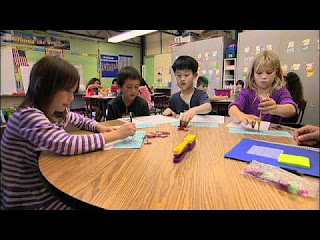

Not my class or my classroom.  :-)
1) Introduce the Lesson- A variety of activities can be used to introduce the lesson.  Some that I hadn't thought of include: reflecting on previously-learned mathematical concepts, focusing on math vocabulary, demonstrating how to use manipulatives, emphasizing the importance of students monitoring their own work, and encouraging the use of multiple representations of mathematical ideas. 
2) Present the Activity or Task- Students should be provided rubrics, checklists, or examples of other student work for similar activities with the intention of helping them to self-monitor and produce higher-quality work that reflects deeper mathematical understanding. 
3) Encourage the Use of Multiple Strategies-I think that such a great way to do this (as suggested by Sammons) is allowing students to choose which problem-solving strategy to use.  The benefit of doing so is that student mathematical understanding will move from concrete to abstract. 
4) Scaffold Learning- Scaffolding is one of those currently hot education "buzz words."  I appreciate that it is defined here as including the following elements:
  • occurs with assistance and is a social process
  • involves inter-subjectivity (seeking a common view)
  • is provided with warmth and a responsiveness toward students' needs
  • is focused
  • avoids failure
  • is temporary
5) Promote Mathematical Discourse- Math communication (both oral and written) promote student understanding.  It also helps students to retain their learning longer.   

6) Promote Learning by Giving Feedback- According to Anne Davies, descriptive feedback:
  • comes both during and after the learning
  • is easily understood
  • relates directly to the learning
  • is specific, so performance can improve
  • involves choice on the part of the learner as to the type of feedback and how to receive it
  • is part of an ongoing conversation about the learning
  • is in comparison to models, exemplars, samples, or descriptions
  • is about the performance or the work-not the person
I especially am intrigued by Sammons's idea to instruct students in what exactly effective feedback is so that they may evaluate themselves and/or their peers. 

AFTER the lesson, the TEACHER should:
  • keep records of informal assessments
  • select the next steps for instruction
  • identify students who are falling behind
  • and, at times, change the composition of the groups
Wow, this chapter (and therefore, this post) was HUGE!!!  Having read only this far, I have a feeling that it will be the best chapter in the book (most applicable).  I came away from it with lots of real-world knowledge of what guided math small groups look like when implemented in the classroom.  This is SO nerdy (but I know I'm not the only one who feels this way), but I can't wait to get back to school and try it all out!!!  :-) 

I'm off to go read chapter 6, so I can get back on track with the book study.  I'll be back soon!

Saturday, June 30, 2012

Guided Math Book Study Chapter 4 and My Blog's First Award!!!

Hell-oooooooooo blog world!!!  I have been a prisoner of my grad school class for the month of June.  I'm so excited about the little break I have before the second session starts up in a few weeks!!! 

First things first:

I was awarded the One Lovely Blog award by Where Seconds Count. 


As I said, I was given this award by:


Where Seconds Count


Thank you, thank you, thank you!!!  :-)


Once you receive the award, you must follow 3 rules:

1. Follow the person that gave you the award

2. Link back to the person that gave you the award

3.Pass the award on to 15 new bloggers

I have chosen the following blogs to award:

1) What the Teacher Wants

2) Thinking of Teaching

3) The Teacher Wife

4) Teaching in Flip Flops

5) Sweet Seconds

6) Step Into 2nd Grade with Mrs. Lemons

7) Primary Graffiti

8) Pitner's Potpourri

9) One Extra Degree

10) My Second Grade Journal

11) Mrs. Freshwater's Class

12) Lory's Page

13) Hopelessly Devoted to Teaching

14) First Grade Glitter and Giggles

15) Create●Teach●Share


Now on to Guided Math Chapter 4!!! 

This chapter was all about whole class implementation of Guided Math.  Here are my thougthts:

1) Whole class instruction is certainly appropriate in some situations.  Those include: mini-lessons (another link I saw to reading instruction!!!), activating strategies, math read alouds (this is something I'd like to incorporate more), setting the stage for math workshop, Math Huddles, practice and review, and formal testing/assessment.  As I implemented the Daily 5 in reading last year, I can certainly attest to the importance of setting up routines, and in this case, setting the stage for math workshop.

2) I think the biggest challenge that Sammons mentions with regard to whole group instruction is the inability to provide timely and appropriate feedback.  This is SO, SO important for your struggling learners.  The danger here is allowing students to incorrectly learn and reinforce this.  Very difficult to undo once it has been cemented. 

3) I'm so glad that Sammons provides us with the sample architecture of a mini-lesson.  I can't wait to try it out!

4) With regard to activating strategies, I have a confession to make.  With KWL charts I have used, of course I had students fill out the "L" column stating what they have learned.  HOWEVER, I never had them revise what they thought they knew.  BAD TEACHER!!!  This was such a "Duh!" moment for me.  I'm a bit ashamed. 

5) As my district moves from Envision to Investigations, I'm excited to adapt the KWL charts for problem solving as Sammons suggests (p. 119). 

6) I'm not sure what I think about Word Splashes yet.  I am willing to give it a try, and I think it will really work well with Thinking Maps, which my school has adopted for the coming school year.  What do you think about this strategy?  Will you try it with your students?

I need to get reading Chapter 5 (remember a few posts ago, when I detailed the saga of my defective book that was missing 30 pages?).  Anyway, Laney Sammons came to my rescue and sent me a new book, so I'm good to go.  I can't wait to catch up on the book study. 

Until next time,


Thursday, June 21, 2012

Guided Math Study Chapter 3 (a day late) :-)

Here are my thoughts on chapter 3:

1) I wish my school was open (even though grad school has me way to busy to visit), so that I could use pictures of my own classroom instead of Google images.

2) Now for the book chapter: I'm so loving this book study because it is giving me lots of ideas.  Our math curriculum is changing this year, and until I attend training on it in July, I'm COMPLETELY in the dark about Investigations.  Does anybody use this for math?  Do you have any information to share?

3) I really want to implement math journals, and I think Math Stretches might be a good way to do so.  I am especially interested in the Number of the Day and What's Next math stretches.  I think that these are feasible and would be engaging for 2nd graders to do.

I love these composition books.  We use them for writing, but I think they'd work great for math and science too!


4) I really like how Sammons points out the relationship between discussion and writing in math, and how they are both important.  I know it will help my students to have a few minutes to write down their thoughts prior to a discussion so that they are prepared.  I think it would even be good to allow them time to talk to a partner before the whole class discusses so that they can experience and share in multiple ideas.

5) I think that the "______ Makes Me Think of..." stretch will be VERY easy to integrate with Thinking Maps (don't you agree? :-) )  What a great way to encourage making math connections/establishing relationships between math concepts.

6) I feel very good about my use of calendar time.  It teaches so many important math skills.  This is the calendar I have in my room, even though, it is not THE exact one.  This is an area I would like to grow in.  What do you include in your calendar time?


7) Final thoughts: I LOVE the idea of a problem of the day, and I hope that the Investigations curriculum lends itself to this.  Also, I like the proposed schedule of math stretches that Sammons offers (e.g. doing the same kind of stretch each weekday- What's Next on Mondays, etc.).  

I'm looking forward to practical implementation advice that will come in Guided Math's next chapters as Sammons discusses math in different groupings (Whole Class, Small Groups, etc.)

Sunday, June 17, 2012

Guided Math Book Study Update

I just wanted to stop by to share something awesome that Primary Inspired has done.  She has created a button for those of us that are participating in/otherwise interested in the book study for Guided Math.  It will take you to a page on her blog that has all of the info you need to follow/participate in the book study.  How cool!!!

Photobucket

Saturday, June 16, 2012

A Bump in the Blog Book Study Road

Thank goodness I'm a little intense when it comes to reading because I was able to discover a problem with my Guided Math book in plenty of time.  I was reading ahead in Guided Math, only to discover that 30! pages of my book were missing from chapter 5 (Oh no!!!).  I contacted Laney Sammons, and she has been so wonderful.  She has forwarded my message to her publisher and promised to send me a new book.  Hopefully I will have it so that I can keep up with the book study.  Anyway, she's great!

Laney Sammons- my new hero!!!
Anyway, I think that everything will be okay.  The moral of this story is to always check your books before purchase to make sure that they have all of their pages.  :-)  In the mean time, I have plenty to read to keep myself busy.  I'm reading many, many, many articles from this book as part of my grad school class:


AND, I need to take the test and get started on this book as part of my school's summer book study (that we will continue throughout the fall):

I like hard copies, I don't have a Kindle.

Anyway, I'm looking forward to all of the reading I'll be doing this summer.  I just need to get some fun "beach reads" onto my reading list.  What are you reading this summer?


Friday, June 15, 2012

Guided Math Book Study- Chapter 2 Reflection

First of all, thank you so much to those of you that are following my new blog.  I appreciate your patience and support as I learn the ropes.  One thing that I'm really enjoying about blogging is connecting with teachers and sharing ideas as part of the Guided Math book study.

With that said, here we go!  :-)  

1) The first thing that I really appreciated about this chapter was the immediate parallel that Sammons drew between guided reading and guided math.  I think that this will go along way to make teachers (myself included) feel less intimidated by guided math.  Many of the routines we already have in place for guided reading can easily be modified to be appropriate for guided math.  

2) The 7 foundational principles of a guided math classroom: All of these principles can be classified as best practices.  Students should work together, talk together, actively be involved in mathematics, and have a teacher that is ready to model, model, model.  

3) I enjoyed how Sammons addressed equity, stating that the different components of guided math help teachers to "provide scaffolding and support for all learners based on their needs" (39).  In this way, all students can be taught with equity rather than equality.  

4) I think that the importance of communication (oral and written) in math cannot be overstated.  As Sammons points out, although we realize the importance of math communication, it unfortunately has played "such a limited role in elementary-school mathematics instruction" (39).  I have only ever taught students who were learning English as a second language, so I can say with utmost confidence that achieving communication across the disciplines for these students is all about building confidence.  Students should be offered low-risk opportunities to communicate, so that they may begin to feel more and more comfortable with communicating and sharing in class.  

5) Classroom arrangement: I'm so excited to be reading this book now.  I'm one of the lucky (cursed?) teachers who keeps moving schools/classrooms, so this August, I will once again have the opportunity to build my room from scratch, arranging everything the way that I want it.  I'm making myself a mental note now to make sure that it is all set up for guided math.  Additionally, Sammons has helped me with the arrangement of my student desks.  I have always done groups in the past, but was considering rows this year (all of my teammates seat their students in rows).  I have decided to stick with groups and now I have the justification for it- yay!!!

6) A numeracy-rich environment: Wow, did this section have a lot to offer!!!  I like that Sammons teased many things that she will cover in more detail in later chapters (it just motivates me to keep. on. READING!!!).  This year is going to be a bit "funky" in math because my district is moving towards a more problem-based approach, and until I attend training on it next month, I'm completely in the dark.  I do know that many, many manipulatives will be involved, but that's pretty much it.  I would still like to do a problem of the day if I can.  I imagine that the new math curriculum will work well with math word walls, math journals, and graphic organizers.  Especially exciting, is that my district has just adopted Thinking Maps, so I know that graphic organizers can be easily incorporated into our math time.  

I feel like this blog post is just dropping off, but in closing, I'll just say that I'm looking forward to reading and discussing chapter 3.  Thanks for reading!!!


Wednesday, June 13, 2012

Guided Math Book Study-Chapter One Reflection

I'm so excited to be participating in this book study (it is largely the reason that I joined the blogosphere).  I can't wait to connect with other motivated teachers.  Here are some thoughts I had as I read chapter one:


1) I wholeheartedly agree that the main problem with the old method of mathematics instruction (teacher-centered, whole group 100% of the time) is that several students were engaged in solving problems in front of the class, but the majority of the class was disengaged.  While Sammons does not directly state this, it is heavily insinuated.

2) I'm so glad that Sammons called attention to the achievement gap related to mathematics between affluent students and minority students/students living in poverty.  I saw this first hand at my school last year, and I am ready for this gap to narrow/close.

3) I like that Sammons points out that "teachers struggle to find the time to help them [struggling students]."  I know that this book will be very helpful to teachers who are struggling with finding the time to give every student what he needs, when he needs it (aren't we all?).

4) Sammons places an importance on mathematical dialogue.  I would go even further to say that students need to develop mathematical literacy.  She previews some of her math work stations in later chapters, including math journals, so I believe that she will address this issue.  I can't wait to read what she has to say about it.  I know that this is important not only for our English Language Learners, but all of our students.

5) At this point, as Sammons has previewed her model and all of its components, I am reminded of what I know of The Daily 5 and the CAFE framework.  Both have components of whole group (I'm glad that Sammons asserts that whole group instruction still has its place, but cannot be the only method of math instruction), guided instruction, small groups for stations, as well as individual conferences.

In summary, I'm so glad that I decided to pick up a copy of this book and participate in this book study. The first chapter teases many great things to come in the remainder of the book.  I'm particularly looking forward to chapter 3.  Since I have taught older grades in the past, calendar math is somewhat new to me (I'll be teaching 2nd grade this year).  What do you include in your calendar math?
Related Posts Plugin for WordPress, Blogger...