"In spite of time constraints, which often lead teachers to emphasize procedural fluency over conceptual understanding and to use worksheets rather than problem-solving activities, we want more for our children" (p. 133). As a teacher of English Language Learners, I think the above statement has
so, so many ramifications. We all want to be the teacher that seeks to instill conceptual understanding in our students. While I do think they have their time and place, I am really, REALLY not a fan of worksheets. Instead, I LOVE journals and blank paper. With this, students are able to communicate what they know, in their language, which is so powerful for our students that have not achieved academic English fluency.
I'm so glad that Sammons explains the purpose of small group instruction as providing students with a toolbox of strategies. This idea will really help me to focus my small group instruction (reading AND math) next year.
Advantages of Small-Group Instruction:
1) Tailored instruction to meet ALL learners' needs
2) Instruction is differentiated.
3) All students have the opportunity to engage in mathematical communication
4) Teacher monitoring of student behavior and math understanding of all students (formative assessment)
Challenges of Small-Group Instruction:
1) Planning may seem overwhelming.
2) On-going assessment.
3) Each student receives less direct-instruction time.
4) Planning independent work for students not meeting with the teacher.
5) Implementing procedures and setting expectations for math workshop.
Effective Uses of Small-Group Instruction:
1)
differentiating instruction- I love that Sammons quotes Carol Ann Tomlinson (I LOVE her) as describing differentiated instruction as a teaching philosophy rather than something that we incorporate into our instruction when we have the time. I think that it is so important that we focus on all of our students needs, not just the struggling ones. Again, Tomlinson ROCKS when she explains (through the interpretation offered by Sammons) that what students learn is the same, but the way in which they learn it is different.
2)
teaching mathematical "hot spots"- I love the use of this term to describe those concepts that give students a hard time year after year (such as subtraction with regrouping).
3)
teaching with manipulatives- I think that the way these tools are used makes or breaks their effectiveness. I like that Sammons explains that using manipulatives with mathematical communication is the formula for conceptual understanding and long-term learning.
4)
assessing student learning informally- Teachers complement summative, end-of-unit tests with daily work, homework, quizzes, and projects. Time to introduce another of my favorite technology tools and my favorite way to assess informally and continuously. Meet, the CPS "clickers" by eInstruction:
These are such neat little tools. They come with a receiver, and you can use them for a variety of assessments. My favorite is "verbal mode." In this mode, I can show a typed page of questions, allow the students to enter their answers, then grade as we go when I enter in the correct answer. We are able to get through many questions and go over answers, offering any explanations necessary in a very efficient manner. I check these out from my campus technology, but again, would LOVE to have some of my very own. Of course, eInstruction does not know that I am writing about their AWESOME tool, and I have not been paid nor given anything to do so.
I had another "Ah-ha!" when I realized (with the help of Sammons) that students can play a role in goal-setting and the formative assessment process itself. Hello?! How did it take me this long to figure that out?
5)
supporting mathematics process standards- It was not surprising to me that process standards get neglected in favor of content-related standards. Again, it was unsurprising to me that many teachers are unsure how to teach process standards. This seems like a great topic for professional development. At the elementary level, since we are in charge of multiple disciplines, I feel like professional development tends to be more general or alternatively focused on reading.
Forming Small Groups for Learning:
This is an area that is a bit scary for me going into next year as we switch from Envision to Investigations in math. With Envision, I often employed pre-tests using the paper and online materials. I think the idea of using a combination of measures will be somewhat freeing: pre-tests, evidence of learning from previous sequential concepts, formative tests, observations, conversations, and benchmark data. I think that the most important point from this section was how important recording anecdotal notes and observations is. I know that it is not new, but I think that I might try the labels on a clipboard, combined with a student data binder method of note-taking this year, like the example shown below (this is the year that I get SUPER organized). :-)
 |
| I like how post-its were added to this example to allow for documentation in multiple subject areas, all kept in the same place. |
Organizing for Small-Group Instruction:
1) Identify the Big Ideas: These ideas make up the foundation for mathematical growth.
2) Establish Criteria for Success: I like the emphasis on collaboration when establishing criteria for success.
3) Use Data to Form Groups: Some things I will take from this section are her scheduling tips as well as the caution to not neglect the higher-achieving students. I like the idea of a weekly schedule, with groups that can change each day as some students "get" concepts and need to be moved to a higher group.
4) Determine Teaching Points: Instruction is determined in response to how groups are formed by common needs. The curriculum standards and assessment are both used to determine teaching points.
5) Prepare Differentiated Lessons: Sammons really thoroughly addressed differentiation through length and frequency of small-group lessons, content to be covered, as well as student learning styles.
6) Gather Materials: Sammons really stresses the importance of planning ahead and anticipating any materials that you might need, especially if the students struggle with the planned learning.
Teaching a Guided Math Lesson with a Small Group:
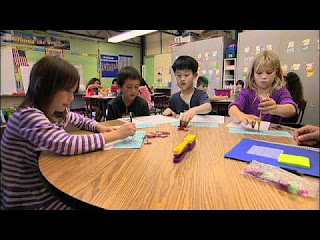 |
| Not my class or my classroom. :-) |
1) Introduce the Lesson- A variety of activities can be used to introduce the lesson. Some that I hadn't thought of include: reflecting on previously-learned mathematical concepts, focusing on math vocabulary, demonstrating how to use manipulatives, emphasizing the importance of students monitoring their own work, and encouraging the use of multiple representations of mathematical ideas.
2) Present the Activity or Task- Students should be provided rubrics, checklists, or examples of other student work for similar activities with the intention of helping them to self-monitor and produce higher-quality work that reflects deeper mathematical understanding.
3) Encourage the Use of Multiple Strategies-I think that such a great way to do this (as suggested by Sammons) is allowing students to choose which problem-solving strategy to use. The benefit of doing so is that student mathematical understanding will move from concrete to abstract.
4) Scaffold Learning- Scaffolding is one of those currently hot education "buzz words." I appreciate that it is defined here as including the following elements:
- occurs with assistance and is a social process
- involves inter-subjectivity (seeking a common view)
- is provided with warmth and a responsiveness toward students' needs
- is focused
- avoids failure
- is temporary
5) Promote Mathematical Discourse- Math communication (both oral and written) promote student understanding. It also helps students to retain their learning longer.
6) Promote Learning by Giving Feedback- According to Anne Davies, descriptive feedback:
- comes both during and after the learning
- is easily understood
- relates directly to the learning
- is specific, so performance can improve
- involves choice on the part of the learner as to the type of feedback and how to receive it
- is part of an ongoing conversation about the learning
- is in comparison to models, exemplars, samples, or descriptions
- is about the performance or the work-not the person
I especially am intrigued by Sammons's idea to instruct students in what exactly effective feedback is so that they may evaluate themselves and/or their peers.
AFTER the lesson, the TEACHER should:
- keep records of informal assessments
- select the next steps for instruction
- identify students who are falling behind
- and, at times, change the composition of the groups
Wow, this chapter (and therefore, this post) was HUGE!!! Having read only this far, I have a feeling that it will be the best chapter in the book (most applicable). I came away from it with lots of real-world knowledge of what guided math small groups look like when implemented in the classroom. This is SO nerdy (but I know I'm not the only one who feels this way), but I can't wait to get back to school and try it all out!!! :-)
I'm off to go read chapter 6, so I can get back on track with the book study. I'll be back soon!







 Posts
Posts